M. de Treville
The Three MusketeersM. de Treville is the captain of the King's Musketeers, a Gascon officer whose rise from poverty to royal command makes him both a living model for d'Artagnan and a central broker of opportunity in the novel. His career joins audacity to disciplined fidelity: he advances by courage and intelligence, becomes trusted by Louis XIII, commands a formidable corps, and repeatedly converts that trust into protection and advancement for the young man who seeks his aid.
Identity and Rise
M. de Treville began life much as d'Artagnan does, without money but with the audacity, shrewdness, and intelligence associated with a poor Gascon gentleman. His original family name was M. de Troisville, while in Paris he came to style himself M. de Treville. The difference in name marks not a change of character but the movement from provincial beginnings into the world of court and military power.
His ascent is described as a rapid climb up the difficult ladder of Court Favor. Insolent bravery and repeated success in an age when blows fell frequently carried him upward four steps at a time. The image is important because his advancement does not arise from inherited wealth. His father, a faithful companion of Henry IV, could leave him little material fortune: only a sword, a spotless name, and the motto FIDELIS ET FORTIS. The motto means that fidelity and strength, rather than property, are the resources on which his public identity is built.
M. de Treville makes effective use of that inheritance. He enters the household of the young prince and proves himself so faithful to his motto that Louis XIII regards him as an exceptionally reliable companion in combat. The king is said to have considered himself an ideal second for a friend who was about to fight, with Treville next to him, or perhaps before him. Treville's value therefore lies not simply in physical bravery but in the combination of obedience, readiness, and judgment that makes courage useful to a monarch.
Captain of the Musketeers
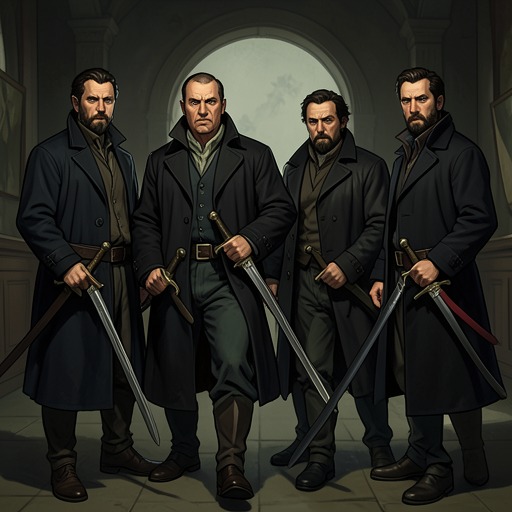
Louis XIII eventually appoints M. de Treville captain of the King's Musketeers. The corps is not merely an ordinary military unit: it is the king's chosen body, held together by devotedness bordering on fanaticism. Treville stands at its head as the trusted commander of a group that functions simultaneously as a fighting force, a royal household, and an instrument of political confidence.
The captain's position also places him within the rivalry between Louis XIII and Cardinal Richelieu. When Richelieu sees the formidable guard surrounding the king, he creates a competing body of Cardinal's Guards and seeks celebrated swordsmen from across France and beyond. The two rulers publicly condemn duels and brawls while privately taking pleasure in the contests between their servants, even disputing over the merits of their men during chess games. Treville's command therefore represents more than military prestige: it is one side of a struggle in which personal loyalty, martial reputation, and political authority are inseparable.
By the time d'Artagnan's father recommends him, Treville is described as captain of the Musketeers, chief of a legion of Caesars, highly esteemed by Louis XIII, and feared by Richelieu. He earns ten thousand crowns a year and is recognized as a great noble, yet the contrast between his present rank and his impoverished beginnings remains essential. His life demonstrates the possibility that his father presents to d'Artagnan: a gentleman may make his way through courage alone.
Patronage of d'Artagnan
Before d'Artagnan reaches Paris, his father directs him to M. de Treville as an example and as the person who may help him enter the royal military world. The advice is practical as well as aspirational. The elder d'Artagnan recalls Treville as a former neighbor in Gascony and as a childhood playmate of Louis XIII, then points to the career built from that connection, repeated fighting, and unwavering service. Treville is thus presented as the attainable pattern by which the inexperienced young man may measure himself.
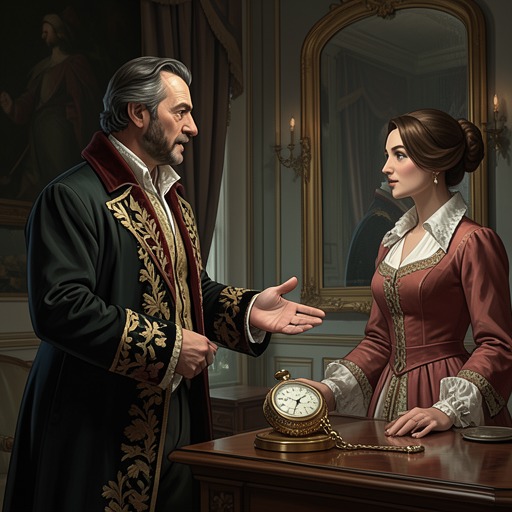
When d'Artagnan appears before him, Treville is in an ill humor, but he greets the visitor politely. The young man's Bearnese accent recalls Treville's youth and homeland, softening the encounter with a double memory of place and time. Treville's first response is not sentimental indulgence; he is occupied with the affairs of his officers and calls Athos, Porthos, and Aramis before turning fully to the newcomer. Yet the audience establishes an immediate connection between the provincial aspirant and the captain who understands the world from which he has come.
Treville soon appreciates d'Artagnan and develops genuine affection for him. Although d'Artagnan is not initially a Musketeer, Treville recommends him repeatedly to the king. Through that support, the young man is admitted as a cadet in the company of Dessessart's Guards. The appointment is not the destination d'Artagnan wants—he would exchange the uniform for that of a Musketeer at almost any cost—but Treville promises that a two-year novitiate may be shortened if d'Artagnan renders the king a notable service or distinguishes himself through a brilliant action. Treville therefore offers both a place within the military hierarchy and a conditional path toward the higher status the young man desires.
Commander, Protector, and Ally
Treville's patronage extends beyond formal recommendation. D'Artagnan adopts the routines of his three friends, accompanies whichever of them is on guard, and performs the duty of a Musketeer with striking punctuality even before he officially belongs to the corps. He becomes well known at the Hotel of the Musketeers as a good comrade. Treville's recognition helps make this informal belonging visible: the captain's affection and continuing advocacy give institutional weight to the fellowship that has formed among the four young men.
Later, while the army is encamped before La Rochelle, Treville learns that Louis XIII will travel secretly to Saint-Germain with an escort of only twenty Musketeers. Knowing the young men's urgent desire to return to Paris, although he does not know the reason, Treville selects them for the escort. His decision becomes the practical means by which they can leave the camp together. It also allows d'Artagnan, now finally admitted to the Musketeers through Richelieu's intervention, to travel with his companions rather than remain behind.
The favor is especially consequential because the four men are trying to protect Madame Bonacieux from Milady the English spy. Aramis has obtained an order authorizing Madame Bonacieux to leave the Carmelite convent at Bethune, but the order is of little use while the friends remain at La Rochelle, at the opposite end of France. Treville's escort solves that immediate logistical obstacle. He does not direct the rescue himself, but his command decisions create the opening through which the rescue attempt can proceed.
When the escort reaches Paris on the night of the twenty-third, Louis XIII thanks Treville and permits him to distribute furloughs of four days, under penalty of the Bastille for appearing in public. Treville gives the first four furloughs to Athos, Porthos, Aramis, and d'Artagnan. He also allows Athos six days instead of four and effectively adds two nights by adjusting the dates. This combination of formal authority and discreet flexibility gives the friends the time they need for their mission. Athos's warning that Bethune is dangerous because the Cardinal has arranged a meeting there with a woman who brings misery wherever she goes shows how heavily the captain's decision bears on the unfolding pursuit of Milady.
Reputation and Narrative Significance
M. de Treville's reputation reaches beyond the Musketeers. When Milady tries to establish her credentials before a novice, she claims intimate acquaintance with Monsieur de Treville and identifies him as the captain of the king's Musketeers. Whether such claims are entirely trustworthy is less important than the authority his name carries: Treville is a recognizable connection to royal power, military respectability, and the inner circles of France.
His presence at the end of the narrative confirms the durability of his relationship with the four friends. Three days after Milady's execution, the Musketeers return to Paris without exceeding their leave and pay their customary visit to Treville. He greets them by asking whether they have been well amused during their excursion, and Athos answers on behalf of himself and his comrades that they have been so prodigiously. The exchange is dry in proportion to the violence and danger they have just survived. Treville remains the fixed institutional point to which the wandering companions return.
As a character, Treville occupies the boundary between mentor and power broker. He does not replace d'Artagnan's courage, nor does he undertake the young man's adventures for him. Instead, he recognizes ability, provides access, protects loyal subordinates, and turns royal favor into concrete opportunities. His own history explains why he can see potential in a penniless Gascon: he has traveled the same road from sword and motto to command. At the same time, his position reveals the cost and ambiguity of that road. Advancement depends on fidelity to a king, participation in a culture of dueling, and navigation of the contest between Louis XIII and Richelieu. Treville therefore embodies both the ideal of gentlemanly advancement through courage and the political machinery that makes such advancement possible.